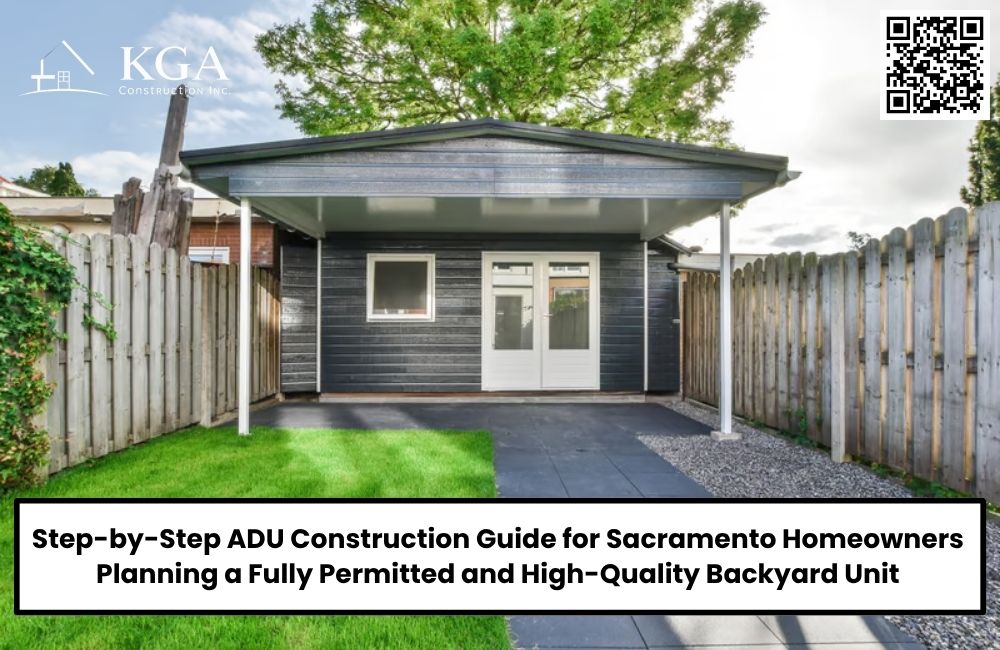
Step-by-Step ADU Construction Guide for Sacramento Homeowners Planning a Fully Permitted and High-Quality Backyard Unit
Building an ADU the Right Way Starts Long Before the First Shovel Hits the Ground
There is something genuinely exciting about deciding to build a backyard ADU in Sacramento. The possibilities feel immediate and tangible a beautiful detached cottage generating reliable monthly rental income, a private space for a family member who needs independence without distance, or simply a smart structural investment in a property that has been appreciating steadily for years. That excitement is completely justified. A well-built, fully permitted Sacramento ADU is one of the most financially rewarding decisions a homeowner can make in today's Northern California real estate environment.
But excitement without preparation is how good ideas become expensive problems. The Sacramento homeowners who end up with ADUs are genuinely proud of units that pass every inspection, command strong rents, and hold their value for decades are the ones who approached the project with a clear understanding of what the process actually involves from beginning to end. They knew what steps came in what order. They understood what their lot could realistically accommodate before committing to a design. They selected a qualified ADU contractor before they needed one rather than scrambling after decisions had already been made. And they planned for outdoor improvements, patio construction, shade structures, landscaping as part of the original project rather than as afterthoughts.
This step-by-step guide gives you exactly that, understanding a clear, honest, Sacramento-specific roadmap that takes you from initial idea through completed, certificate-of-occupancy-approved backyard ADU.
Step 1: Clarify Your Goals and Establish Your Decision Framework
Every successful ADU project begins with the same foundation a clear, specific articulation of what the ADU needs to accomplish and what constraints it needs to work within. This is not a bureaucratic exercise. It is the thinking that makes every subsequent decision easier, faster, and more aligned with outcomes that will actually satisfy you when the project is complete.
Define the ADU's Primary Purpose
What the ADU is for shapes everything about how it should be designed. A rental unit targeting long-term tenants in Rancho Cordova has fundamentally different layout priorities than a private suite created for an aging parent in El Dorado Hills. A short-term vacation rental in a Folsom neighborhood near recreational amenities needs different amenities and finishes than a detached home office studio intended for focused solo work. Getting specific about purpose before engaging any ADU builders near me ensures that your eventual design serves real goals rather than generic assumptions.
Write down your answers to these questions before your first contractor consultation: Who will live in the ADU? What is their daily routine? What do they need the unit to provide that their current living situation does not? What is the one thing the ADU absolutely must get right to be considered a success? These answers become the filter through which every subsequent design decision is evaluated.
Set a Fully Loaded Budget Not Just a Construction Number
The most consequential financial mistake Sacramento ADU owners make is conflating the construction cost with the total project cost. A fully loaded ADU budget includes architectural and design fees, permit application costs across all required jurisdictions, site preparation and grading expenses, utility connection and upgrade costs, active construction across all phases, interior finishing and fixture selections, outdoor improvements including patio construction and shade structures, and a 10 to 15 percent contingency fund for the unexpected conditions that Sacramento's variable soil and aging utility infrastructure regularly produce.
Homeowners who establish a fully loaded budget before their first contractor meeting have productive, focused conversations. Those who arrive with only a rough construction number in mind frequently experience genuine financial shock when the complete picture comes into focus mid-project at exactly the moment when turning back is most expensive.
Step 2: Assess Your Sacramento Property's ADU Potential
Before falling in love with any particular ADU design, invest time understanding what your specific property can actually accommodate. Sacramento's ADU regulations have become significantly more homeowner-friendly in recent years, but individual lot characteristics still create important constraints that should shape your design thinking from the beginning.
Know the Rules That Apply to Your Specific Address
California state law sets the baseline framework for ADU development statewide allowing most single-family lots to host at least one ADU and one junior ADU simultaneously, setting maximum rear and side setbacks as low as four feet for detached structures in many zones, and establishing a statewide maximum ADU size of 1,200 square feet regardless of primary home square footage. These state minimums are meaningful and favorable but individual Sacramento municipalities layer their own requirements on top of them.
Sacramento City, Elk Grove, Folsom, Rancho Cordova, El Dorado Hills, Roseville, and every other municipality in KGA's service area each maintain their own specific zoning ordinances that govern ADU height limits, lot coverage maximums, design review requirements, and utility connection standards. What is permitted on a lot in one jurisdiction may require modification or outright redesign on a comparable lot in a neighboring city. A qualified ADU contractor with direct experience across multiple Sacramento-area building departments can tell you quickly and accurately what your specific address can accommodate, saving weeks of independent research and protecting you from design commitments that local rules will not support.
Walk Your Property With Fresh, Critical Eyes
Before any professional assessment, conduct your own informal site evaluation. Walk the perimeter of your lot and note where utility connections, electrical meter, gas meter, water shutoff, sewer cleanout are located relative to your planned ADU site. Observe how the ground slopes and where water naturally moves during rain events. Note the location and size of mature trees that might affect ADU placement, setback calculations, or foundation design. Identify the location of any existing structures, garages, sheds, covered patios that might be converted rather than demolished. And consider how access to the ADU will work where the separate entrance will be located, how the occupant will reach their front door from the street or driveway, and how that pathway can be designed to feel private and welcoming rather than awkward.
Step 3: Choose the Right ADU Type for Your Lot and Goals
With a clear purpose defined and a property assessment completed, the next decision is which ADU configuration makes the most sense for your specific situation. Each type has distinct advantages, cost implications, and suitability for different lot conditions.
Detached Backyard Cottage Maximum Privacy, Maximum Returns
A fully independent structure built in the rear yard area of your Sacramento property delivers the greatest privacy for both households, the strongest rental income performance, and the most significant contribution to appraised property value of any ADU configuration. Detached cottages are also the most design-expressive option allowing for the most creative architectural approaches and the widest range of size and layout possibilities within applicable zoning limits.
They require adequate rear yard space, must meet setback requirements on all sides, and represent the highest construction investment among ADU types but the financial returns over time, combined with the property value appreciation they deliver, make them the most compelling choice for Sacramento homeowners with lots that can accommodate them.
Garage Conversion Smart Value on Constrained Lots
When rear yard space is limited or when existing garage infrastructure makes conversion more cost-effective than new construction, a garage conversion ADU delivers strong results at lower overall investment than a detached build. KGA Construction's garage conversion portfolio across Sacramento includes projects that transformed unremarkable single-car garages into impressive studio apartments, spacious two-car garages into fully equipped one-bedroom units, and detached workshop spaces into charming cottages that bear no resemblance to their functional origins.
The key to a successful garage conversion is understanding which elements of the existing structure are genuine assets sound concrete slab, adequate ceiling height, accessible utility connections and which require investment to bring up to habitable standards. An experienced ADU contractor assesses these factors during the initial site visit and builds them into the proposal accurately rather than discovering them as surprises during construction.
Junior ADU The Accessible Entry Point
Converting existing interior space within the primary home into a self-contained junior ADU is the lowest-cost, lowest-disruption path into ADU ownership and for Sacramento homeowners whose primary constraint is budget rather than space, it is often the most strategically sound starting point. JADUs are created from spare bedrooms, basement levels, attached garages with interior access, or other underused portions of the primary home requiring their own private entrance but allowing a shared interior doorway between the JADU and the main house in many configurations.
Step 4: Engage a Qualified ADU Contractor Before You Design Anything
This step surprises many Sacramento homeowners who assume the logical sequence is to develop a design first and then find someone to build it. In practice, engaging a qualified ADU contractor before the design is finalized ideally from the very beginning of the design process produces significantly better outcomes than hiring a contractor to execute a design that was developed without construction input.
Why Early Contractor Engagement Matters
An experienced ADU contractor brings construction knowledge to the design process that prevents the expensive conflicts between design intentions and construction realities that derail projects developed in sequence rather than in parallel. They know which design decisions drive cost up disproportionately and which achieve similar aesthetic results more economically. They understand how their region's building departments respond to specific architectural approaches and can guide design decisions that streamline permit review rather than complicate it. And they can provide accurate cost feedback on design options before those options are finalized ensuring that the design you fall in love with is actually within the budget you have established.
What to Look for When Evaluating Contractors
License verification through the California Contractors State License Board is the non-negotiable starting point. Beyond credentials, the qualities that most reliably predict a great ADU project experience are consistent across the contractor evaluation process. A strong, verified review history from real Sacramento-area clients read in detail rather than evaluated by star rating alone provides the most reliable preview of what your experience will look like. A portfolio of completed ADU projects in neighborhoods similar to yours demonstrates relevant local capability. Direct conversations with past clients whose projects are complete reveal the communication culture and problem-solving approach that formal references rarely capture fully.
When Sacramento homeowners search for ADU builders near me with this evaluation framework in mind, they consistently find that the contractors who check every box are a much smaller group than the initial search results suggest which makes the evaluation process genuinely worth the time it requires.
Step 5: Navigate the Custom Design and Visualization Process
With a qualified ADU contractor engaged and a clear project brief established, the design process begins in earnest. This phase transforms your goals, lot conditions, and budget parameters into specific architectural decisions floor plans, exterior elevations, material specifications, and interior finish selections that will govern every subsequent construction decision.
Custom Design That Reflects Your Property and Your Vision
The best ADU designs are custom creations that reflect the specific characteristics of the property they are built on templates pulled from a catalog and applied without meaningful adaptation. KGA Construction's design process begins with a thorough site analysis that informs every major layout decision orienting the ADU to maximize natural light in primary living areas, positioning windows to capture views while maintaining privacy, locating the entrance for intuitive access without compromising the primary household's yard use, and ensuring that the exterior design language connects naturally with the primary home's architectural character.
Interior layout decisions during this phase carry real consequences for how livable the finished unit will be. Smart space planning in compact ADU footprints prioritizes functional efficiency over decorative ambition ensuring that every square foot serves a clear purpose, storage is genuinely usable rather than cosmetically impressive, and the kitchen, bathroom, and living areas connect in ways that make small spaces feel spacious and comfortable rather than crowded and compromised.
3D Visualization See It Before You Build It
One of the most valuable tools in the modern ADU design process is three-dimensional visualization the ability to walk through a realistic rendering of the finished ADU before any permits are filed or any construction begins. KGA Construction offers 3D visualization as a standard part of its design process, giving Sacramento homeowners the ability to evaluate their ADU design in a realistic spatial context rather than interpreting flat floor plans and elevation drawings.
This capability closes the gap between design intention and finished reality allowing homeowners to request adjustments, experiment with different material and finish combinations, and confirm that the design they are approving for permit submission is genuinely what they want built. The cost of a design revision during the visualization phase is a fraction of the cost of the same revision discovered during construction making this investment in clarity one of the most financially sound decisions in the entire project sequence.
Step 6: Complete Permit Management Let Your Contractor Own This Process
For most Sacramento homeowners, the permit process is the most anxiety-inducing phase of ADU development and it is the phase where the experience differential between contractors is most immediately and consequentially apparent. An experienced ADU contractor who has successfully navigated dozens of permit applications across Sacramento's various building departments moves projects through the approval process dramatically faster than one who is learning the system on your timeline and budget.
What Permit Management Actually Involves
KGA Construction's permit management process begins with the preparation of a complete permit application package architectural drawings, structural engineering, Title 24 energy compliance documentation, site plans, and any required supplemental studies formatted to the specific requirements of the building department with jurisdiction over your property. Applications are submitted with the documentation completeness and formatting precision that minimizes plan check correction cycles.
Once submitted, KGA manages all communication with building department plan checkers throughout the review process responding to questions and revision requests promptly, providing supplemental documentation when requested, and tracking review status to ensure that applications are not lost in administrative queues. When plan check approval is granted, KGA schedules all required inspections at the appropriate construction milestones ensuring that work is consistently ready for inspection before inspectors arrive and that correction items identified during inspections are addressed immediately to maintain project momentum.
Step 7: Execute Construction With Precision and Quality Control
Active construction is the most visible phase of the ADU project and the phase where the daily discipline of your contractor's project management team most directly determines whether the finished product meets the standard that the design process promised.
Foundation and Structural Work The Invisible Backbone
Every ADU's quality begins underground with the foundation that supports everything built above it and the structural system that determines the building's dimensional accuracy, load capacity, and long-term performance. KGA's construction crews approach foundation work with the engineering discipline that Sacramento's variable soil conditions demand selecting foundation types appropriate for each site's specific conditions and executing concrete work with the precision that structural integrity requires.
Structural framing follows, and the quality of framing determines the dimensional accuracy of every subsequent phase. Walls that are plumb and straight produce drywall installations that are clean and gap-free. Roof structures that are dimensionally accurate produce roofing installations that drain properly and weather effectively for decades. The invisible work of competent framing is the foundation on which every visible finish depends.
Mechanical Systems Critical Work Behind the Walls
Plumbing, electrical, and HVAC rough-in installations happen inside wall and ceiling cavities before drywall permanently covers them which means quality and code compliance during this phase are both critical and permanently concealed in the finished product. KGA's mechanical installations are executed by licensed tradespeople, coordinated in the correct sequence by project management, and thoroughly prepared for building department inspection at every required milestone.
Interior Finishing Where Vision Becomes Reality
The finishing phase is where Sacramento homeowners who have waited patiently through months of structural and mechanical work finally see their ADU transform from a framed shell into a real, livable space. Flooring installations establish the material palette. Cabinet and countertop installations define the kitchen and bathroom's quality level. Tile work reveals the precision and care of the finishing crew. Paint and trim bring the interior to its finished state.
KGA's finishing standards hold every trade to the same high bar clean tile cuts, consistent grout joints, seamless paint application, and trim work that reflects genuine craftsmanship rather than rushed completion.
Step 8: Design and Build Your ADU's Outdoor Spaces Simultaneously
Here is the step that homeowners who have completed ADU projects most consistently wish they had taken more seriously from the beginning the deliberate planning and construction of the outdoor spaces surrounding the ADU as part of the original project rather than as separate improvements added later.
Why Patio Construction Belongs in Your ADU Timeline
A private outdoor space adjacent to your ADU whether a concrete patio, paver terrace, or natural stone gathering area dramatically increases the unit's livability and rental appeal. Sacramento renters genuinely value private outdoor space, and a well-designed patio adjacent to an ADU consistently justifies higher monthly rents than an identical unit without defined outdoor space. The financial case for incorporating patio construction into your ADU project is straightforward the rental income uplift it generates over time typically exceeds the cost of the improvement within a year or two of occupancy.
KGA's experienced patio builders design and build outdoor spaces that integrate naturally with every ADU using materials that complement the ADU's exterior, layouts that flow naturally from the unit's entrance, and dimensions appropriate for the actual uses the space will support.
Patio Covers Built for Sacramento's Climate Reality
Any Sacramento homeowner who has spent a July afternoon in an uncovered backyard understands the fundamental limitation of outdoor space without shade it is essentially unusable during the hours when most people want to use it. Professional patio cover builders design and install shade structures that transform this limitation into a genuine outdoor living environment that functions comfortably year-round.
KGA's patio cover builders offer the full range of solutions appropriate for Sacramento's demanding summer climate open lattice covers for filtered shade, solid roof panel systems for complete weather protection, insulated panel systems for genuine thermal comfort on the hottest days, and motorized louver systems for the adjustable, technology-enabled outdoor experience that increasingly defines premium Sacramento residential properties.
Step 9: Final Inspection, Walkthrough, and Project Handoff
Every KGA Construction ADU project concludes with the same disciplined final sequence a thorough room-by-room walkthrough conducted by a senior project manager alongside the homeowner, followed by a complete project documentation handoff that gives clients everything they need to rent, refinance, or sell the property with confidence.
What the Final Walkthrough Covers
During the final walkthrough, every surface, fixture, system, and finish is evaluated against the agreed design and quality standard. Electrical outlets and switches are tested individually. Plumbing fixtures are run and drainage is confirmed. Doors and windows are operated and verified for smooth, gap-free performance. Tile work, paint, and trim are inspected for consistency and completeness. Outdoor improvements, patio construction quality, patio cover installation, and landscaping completion are reviewed against the project scope.
Any items requiring attention are documented in writing and corrected before the project is officially closed. KGA does not consider a project complete until the homeowner's walkthrough confirms that every element of the finished ADU meets or exceeds the standard established at the project's beginning.
Why Sacramento Homeowners Choose KGA Construction for Their ADU Projects
KGA Construction Inc. has been delivering exceptional ADU results across the greater Sacramento region since 2006 nearly two decades of hands-on local experience, 100-plus verified five-star reviews, and a full-service team that manages every step of this guide under one roof. As a trusted ADU contractor, experienced patio builders, and skilled patio cover builders, KGA brings the integrated capability that makes the difference between an ADU project that goes smoothly and one that does not.
From the free initial consultation through the final walkthrough and project handoff, KGA's team is with you at every step with transparent pricing, proactive communication, and craftsmanship that Sacramento homeowners consistently describe as genuinely impressive long after the project is complete.
Conclusion: Follow the Steps, Choose the Right Partner, Build With Confidence
Building a fully permitted, high-quality Sacramento backyard ADU is not simple but it is absolutely achievable when you approach it with the right preparation, follow the right sequence, and partner with a contractor who has the local expertise, verified track record, and full-service capability to deliver every phase with excellence.
The steps in this guide give you the roadmap. KGA Construction Inc. gives you the team to walk it with.
Call KGA Construction today to schedule your free ADU consultation and take the first step toward a finished backyard unit you will be proud of for decades.
KGA Construction Inc.
Address: 400 L St, Rio Linda, CA 95673, United States
Phone: +1 (916) 320-6902
